Like Mountian Streams We Part and Meet Again
Panax Ginseng is a bi-monthly column by Henry Westward. Leung exploring linguistic and geographic borders in Asian American literature, especially those with hybrid genres, forms, vernaculars, and visions. The column championship suggests the English language language's congenital borrowings and derives from the Greek panax, meaning "all-heal," together with the Cantonese jansam, meaning "man-root." This peradventure troubling image of one'southward roots as panacea informs the column's readings.
*
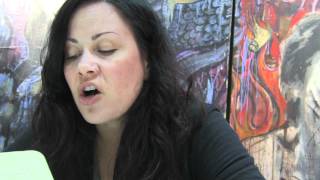 Sharon Lee reading one of her male parent's poems,
from the eulogistic Bruce Lee VLOG Series.
*
Bruce Lee wrote a considerable number of poems, nigh of which were compiled for the first time in Bruce Lee: Artist of Life (Tuttle, 1999), and I've only seen two critical writings on them, both published in The Rumpus a year apart from each other. The first is Dave Landsberger'south "Poetry Kung Fu" from October 2011, and the second is David Biespiel'south "Bruce Lee's Advice to Poets" from his "Poetry Wire" column in November 2012. Landsberger provides a generous reading of several of Lee'south poems with the intention of expanding the public paradigm of the martial arts superstar, of using Lee as a model of artistic sincerity over bogus self-image, and of expressing his own enthusiasm for his layered portrait of Lee. Landsberger's readings of the poems' influences are acute, though his presentation is mayhap overly sentimental, and his exclamatory rhetoric (ironic though it may be) belies the sensationalism he cannot separate from Bruce Lee'south public image fifty-fifty in a treatment of his quieter poetry, equally when he concludes an assay by saying: "Poesy Kung-fu!" Indeed, the essay as a whole—with its demotic reiterations of Bruce Lee non just as a movie star, merely equally a studious "dude who sat on a hood of a auto with Steve McQueen eating cylindrical meats," and sensitive husband to Linda Lee Caldwell—is more of a re-portraiture than a shut analysis of poetry, a marveling at more than a written report.
What concerns me nearly Landsberger's reading, nonetheless, is its binary representation of cultural difference. He tells us early that the above portrait of Lee eating hot dogs with Steve McQueen is "quite peradventure the almost American image this commodity volition see." Later, he must preface an explanation of Lee's themes of longing with, "In Eastern thought . . ." and I'g non entirely sure whether to read this every bit the same application of aesthetic imperialism common to Lee's time (merely replacing the word Oriental with Eastern), or every bit a more modern Orientalism in which the distancing of Lee's work comes out of praise rather than discredit. In whatever example, Landsberger feels the demand to justify Lee's longing by noting, inaccurately: "to Western audiences this ofttimes reads as insecurity . . ." And he concludes the same section with a line offset: "Maybe the merely thing Lee traditionally shares with some famous Western poets . . ." The imprecision of his readings aside, these statements are curious to me because even after all this fourth dimension, even in a modern re-portraiture which addresses the literary sophistication of Bruce Lee's character, Lee is still a shopworn image representing vast cultural differences and misunderstandings.
Landsberger doesn't consider the fact that Lee'south poems are written in English, or that built-in in San Francisco but with a life split between America and Hong Kong, Lee had his choice of languages. That he translated Chinese dynastic poems into English language and that his own poems played with Daoist sensibilities doesn't necessarily place Lee in a position of representing "Eastern thought," especially in an America which had already seen the popularization of Buddhist Modernism. Information technology may exist more apposite to read Lee'south linguistic proclivities as hybrid, non merely on an East/West scale but in the friction of the natural and the urban, a common theme in his early films. Landsberger fixates on the pastoral beauty of Lee's poems, only neglects to detect the urbanity from which they ascend, equally in his Seattle poems attack Lake Washington, and especially in "The Environment Utter No Sound," a good day poem in which the speaker says, "Anxiously I stopped the automobile by the roadside," winding toward a beautiful ending situated somewhere between nature and city:
Like mountain streams, nosotros role and run across again,
Everything is still,
Except the occasional lone bark of a domestic dog.
David Biespiel'due south column has very fiddling to do with Bruce Lee, but also utilizes the sensationalism of Lee's image and performance to make a merits near poetry in general. He extrapolates the following lesson nigh poetry from the popular video of Bruce Lee playing ping-pong with a pair of nunchaku: "Like the accomplishment in the pingpong video, poetry must exude the impossible and reveal the practice that accomplished it. Poetry must understate and overwhelm." What is embarrassing to note is that the video is actually a digital invention with a lookalike actor, first released in 2008 for a Nokia advertizement campaign; the performance exudes the impossible only inasmuch as it'southward entirely fake, which of grade precludes any sedulous exercise to be revealed. What attracts Biespiel to the video is not poesy in the strict formal sense, nor poesy in the broader sense of artistic sincerity and virtuosity (here I disbelieve CG artistry), only poetry as visual performance. This amounts to the appropriation of a body-icon (the lookalike actor in the picture show who, for obvious reasons, never reveals his face to us in total) for audience titillation.
The human relationship betwixt the martial arts and poetry is not remotely modernistic. In generic armed forces histories, warlords and military machine elites tended to be of (or would fight their way into) aristocratic, literary classes by necessity. In Chinese Martial Arts (Cambridge, 2012), Peter Lorge cites a telling example from the Tang Dynasty in which Li Po was invited to recite a poem earlier the emperor while a swordsman put on a weapons demonstration or performance. In Legends of the Samurai (Overlook, 1995), Hiroaki Sato reports an early pairing between samurai of all ranks and the practice of renga, or collaborative linked-verse poetry from which the haiku later derived. Thus, the mere custom of a martial arts superstar in the 1970s who happens to write poetry is not interesting to me equally a fact in itself; what a close analysis might yield, however, is the way in which a bodily fine art can inform a linguistic one since they are both formal conceits in apprehending consciousness.
Consider this comment from recent Ruth Lilly Poesy Prize winner W.S. Di Piero, in his championship essay from When Can I See You Once again? (Pressed Wafer, 2010), on the field of study of Italian painter Giorgio Morandi:
The modernistic sublime isn't most magnitude or clarion ambition: it rubs perception so shut to ordinary facts of physical reality that nosotros experience pressed against a membrane that obscurely separates us from whatever lies on the other side, if there is another side. Information technology intensifies and restores physical reality while suggesting something larger than consciousness.
Now compare that to this passage from Kenji Tokitsu's stunning translation and annotations of the seventeenth-century Japanese sword saint in Musashi: His Life and Writings (Shambhala, 2004):
During combat, the listen of the good comes close to a kind of meditation, because his whole infinite-fourth dimension is filled by the interactive, confrontational field that forms effectually his and his adversary's swords. In other words, in this space-time, apart from this field, in that location is zilch. This field is emptiness, merely emptiness as Musashi defines it in his Roll of Heaven . . .
The lexicon is unlike, only these are 2 artists writing about artists, and both passages speak of an engagement with the world with such density and intensity that immanence gives fashion to transcendence. Grandiosity, bravado, and sensationalism are obviated. Does this not also sound like Rimbaud writing, "The poet makes himself a seer by a long, prodigious, and rational disordering of all the senses"?
Now allow'due south return to Bruce Lee's poetry with "Boating on Lake Washington," which ends:
I try to conjure up the country of dream where I may seek for you.
But, alas, no dreams come.
Merely a moving point of fire in the nighttime,
The distant light of a passing boat.
Daydreams of a unified consciousness—a Romantic sensibility—are frequent in his poems. But this one, it seems to me, is about more than desire or longing, and is more than "verse kung fu." In these lines we encounter the expansiveness of imagination (not just its dreaming of a person, but its conjuring up a land of dream within which more than may transpire) collapsed into a quick regret. And in the terminal images, the vastness of the speaker's confinement sights something originary—fire in the darkness—which becomes remote when unveiled as a transient light. That reads to me like a gesture at consciousness, at a body pressing against a coastal membrane. As a whole, Lee'southward poems may non have been technically achieved, just they do exhibit a vision and sensory disruption worth documenting and inhabiting. Many of them also fall into a category of "martial arts poems," by which I don't mean the insipid limericks hanging from many a dojo, just rather, poems written by adepts of physical pursuits seeking similar heights of consciousness through a linguistic medium. It is a category, a veritable genre, yet to be curated.
Source: http://www.lanternreview.com/blog/2013/03/18/panax-ginseng-toward-a-semiotics-of-the-body/
0 Response to "Like Mountian Streams We Part and Meet Again"
Post a Comment